


Imagine you’re rushing to catch a flight, and you desperately need to find your gate number in a sea of texts, emails, and PDFs on your phone. You type “gate number,” but the actual answer is buried in an email titled “Your Flight Details,” and your search missed it. According to IDC, up to 90% of enterprise data is unstructured, meaning most of the critical knowledge lives in formats traditional search engines fail to interpret.
Now, apply that frustration to a bank, a hospital, or a pharmaceutical lab, where millions of documents—policy texts, clinical notes, research papers—hold the key to life-or-death decisions or multi-million dollar regulatory fines.
Welcome to the corporate data challenge. Traditional keyword search is like looking for a needle in a haystack using a tiny, weak magnet—it only grabs what it’s touching. But what if you had a data superpower?
That superpower is Semantic AI Search, and it’s not just an upgrade; it’s a total revolution.
The Problem: Traditional Search Is Just Too Clueless
The tools we use today are simple, almost childlike. They match words, not meaning.
- If you search for “petroleum vehicles,” it won’t show you documents mentioning “gasoline cars.”
- If you’re a banker searching for “AML risk,” it might miss a crucial email mentioning “suspicious transaction patterns.”
Gartner reports that 34% of employees struggle to find the information they need at work, even with modern search tools. For heavily regulated industries drowning in unstructured data (PDFs, emails, reports, meeting transcripts), this failure to connect the dots is a daily crisis. The most relevant, critical insights stay buried.
Why Semantic AI Search Is the Smarter Sibling
Semantic AI Search doesn’t just look at the words; it looks at what you mean. It’s the difference between a simple spellchecker and a highly trained, domain-specific expert.
It achieves this by using three key technologies:
- Large Language Models (LLMs): These are the ‘brain,’ understanding your natural language query and intent.
- Vector Embeddings: This is the ‘map.’ They translate every concept (like a drug, a side effect, or a patient) into a mathematical representation, allowing the search engine to find related concepts, even if they’re phrased completely differently.
- Knowledge Graphs: This is the ‘relationship network,’ connecting entities and facts. It can show you that “Drug X causes Side Effect Y” and “Side Effect Y is a high-risk factor for Patient Z.”
Instead of missing context, Semantic AI connects the dots. Ask about “elderly CKD patients on metformin,” and you’ll get contraindications, relevant clinical trial results, and warning signs—all in seconds. Gartner’s 2025 Market Guide for Enterprise AI Search notes that generative AI is shifting search from “information retrieval to information synthesis,” highlighting the need for semantic understanding and reasoning.
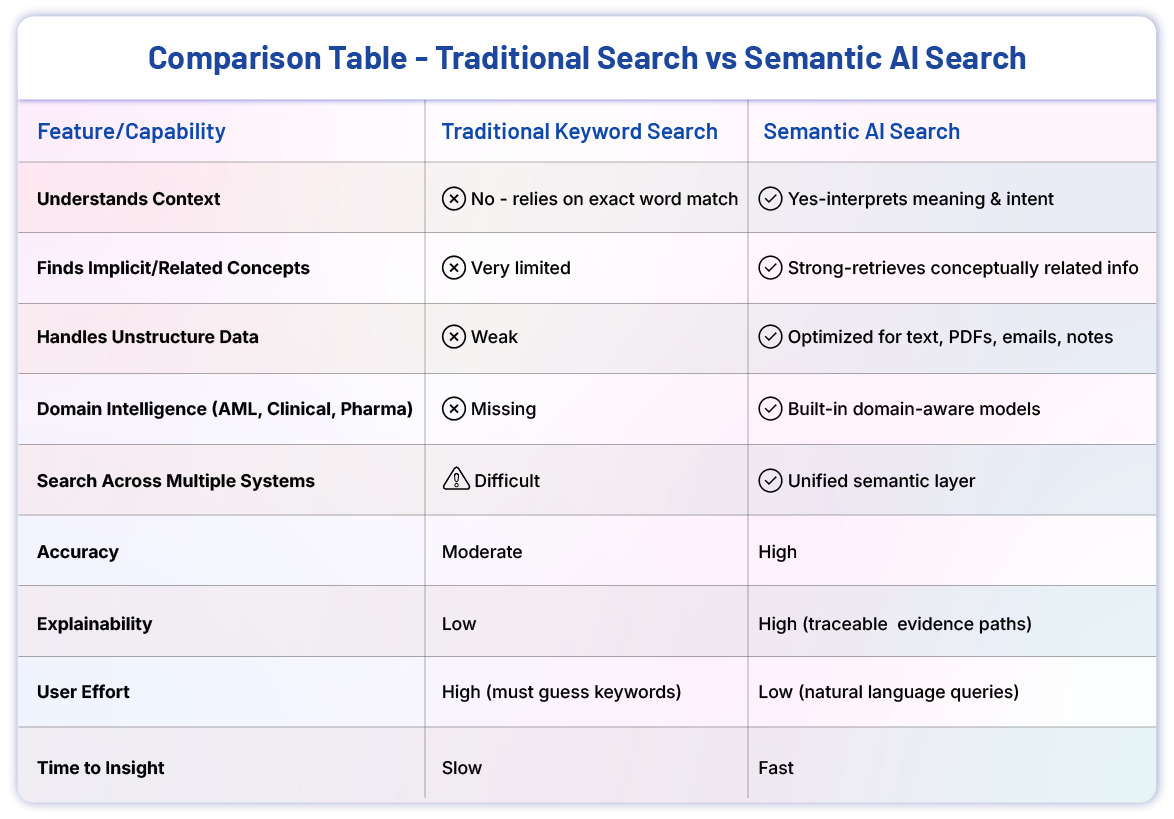
Comparison Table: Why Semantic AI Search Wins the Data Race
This side-by-side view shows why the AI approach is fundamentally better for high-stakes, modern organizations:
Where the Magic Happens: Industry-Specific Impact of Semantic AI Search
Up to 80% of enterprise data is unstructured—it’s a goldmine locked behind a very complex lock. Healthcare systems generate some of the world’s densest unstructured data — IDC reports that 80%+ of clinical information is locked in free-text notes, imaging reports, and transcripts, making traditional search ineffective for clinicians.
Semantic AI tools are the master key. Here is how they are translating data complexity into strategic advantage:
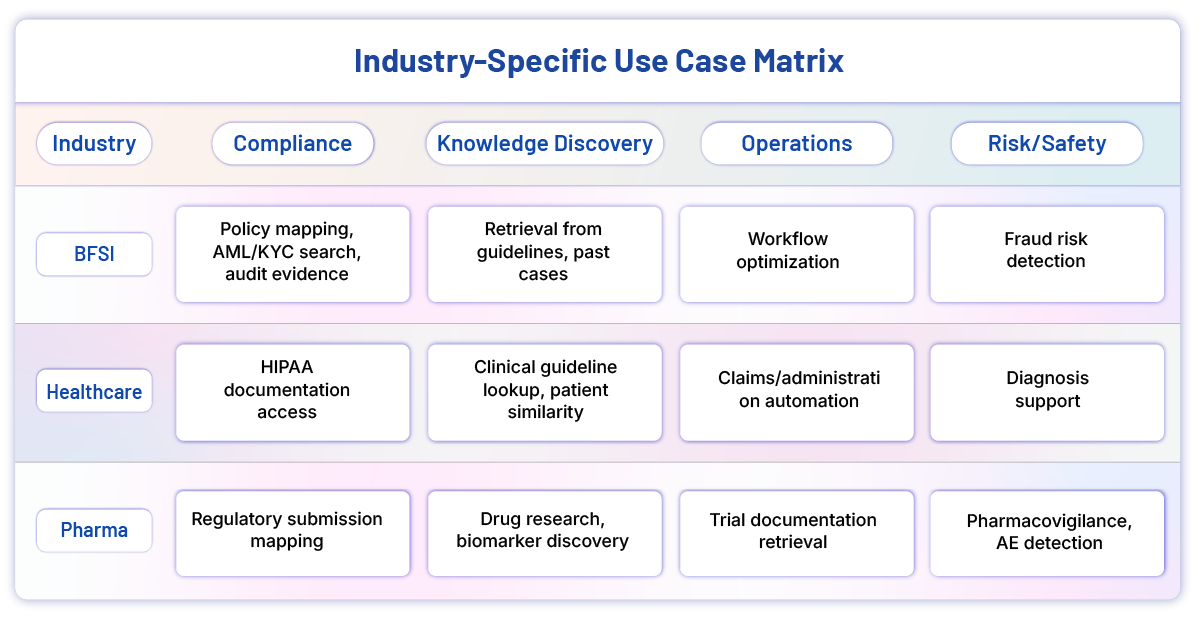
Real-World Impacts:
Banking & Insurance (BFSI)
- Audit Readiness: Instantly collates risks, workflows, and regulatory citations required for an audit, cutting compliance review time by weeks.
- Real-Time Risk: Connects scattered anomalies across transactions, historical reports, and internal emails to flag fraud before it becomes a crisis.
Healthcare
- Clinical Decision Support: A doctor queries naturally and instantly gets contraindications, relevant studies, and patient history, drastically reducing the chance of error.
- Efficiency: Finds hidden patterns in millions of documents to optimize patient flows and claims processing.
Pharmaceuticals
- Accelerated Discovery: A researcher can instantly find all global research linking a specific protein to a disease across hundreds of heterogeneous studies.
- Pharmacovigilance: Flags and aggregates potential safety risks from trial data and global reports, streamlining complex regulatory submissions for faster time-to-market.
In Summary
Semantic AI Search transforms data chaos into business-critical clarity. By unlocking context, connecting concepts, and enabling natural queries, high-stakes organizations finally mine value from their most complex data—at the speed and precision regulators, clinicians, and researchers demand.
With the semantic knowledge graph market surging — nearly 50% of its growth driven by unstructured-data use cases — analysts expect semantic AI search to become a foundational enterprise capability. Evoke’s AI search specialists can help you set up a semantic search for your business and find that needle in a haystack at the snap of your fingers. Contact us.
Stop searching. Start finding.