


Introduction: Why Data Validation Is Time-Consuming and Unreliable
Manual testing, ad-hoc SQL queries, and spreadsheet-based validation slow down releases and introduce hidden risks. As data platforms scale, validation quickly becomes the biggest bottleneck. Fast releases mean little if data quality issues surface silently in production. High-performing teams embed validation into every pipeline run—so problems are detected early, fixes cost less, and stakeholders can trust the data. This blog introduces a Test Automation Framework built using a UI and Microsoft Fabric Pipelines, and data agents, delivered as part of Evoke’s Microsoft Fabric Data Accelerator, that automates source-to-target validation, schema comparison, and data reconciliation.
The Real Problem with Manual Data Testing
Most data teams rely on:
- Manual SQL queries
- One-off validation scripts
- Spreadsheet comparisons
- Post-release issue fixing
- Takes lot of time for validations/comparisons
This leads to high effort, missed issues, delayed go-lives, and low confidence in analytics.
Objective of This Blog
By the end of this article, you will understand:
- Why data testing must be automated
- How UI-driven testing simplifies test creation
- How Microsoft Fabric enables scalable test orchestration
- The core components of an end-to-end data test automation framework
- How this framework fits into Evoke’s Microsoft Fabric Data Accelerator
The Solution: Test Automation Framework on Microsoft Fabric
The Test Automation Framework elevates testing to a core platform capability, enabling consistent and reliable data validation at scale.
Test cases are defined once using a UI, executed automatically using Microsoft Fabric Pipelines, and results are captured centrally for reporting and audit. This framework is implemented as a standard, reusable capability within Evoke’s Microsoft Fabric Data Accelerator, ensuring consistent testing patterns across projects and teams.
What Does the Framework Do?
What: Automates source-to-target data validation, schema comparison, and reconciliation.
Business Benefit: Automates source-to-target data validation, reducing manual effort, saving time, and enabling faster, more reliable testing.
Core Framework Components
- Test Case Repository: Stores source and target details, table mappings, validation type, thresholds, and execution frequency. Configured through a UI without coding.
- Automation Orchestrator: Built using Microsoft Fabric Pipelines. Controls execution order, retries, dependencies, and orchestration of tests.
- Data Reconciliation Engine: Validates record counts, aggregates, and incremental data between source and target systems.
- Record-Level Comparison Engine: Performs row-by-row comparison using business keys. Captures mismatched records with tolerance handling.
- Data Agents: Data agents built on the Lakehouse enable users to query data using natural language through the UI, automatically translating business questions into executable queries for validation and testing.
- Results & Exception Repository: Stores execution status, pass/fail metrics, error messages, and failed records for audit and analysis.
- Test Reporting Dashboard: Provides visibility into test coverage, success rate, failures, and data integrity trends using Power BI.
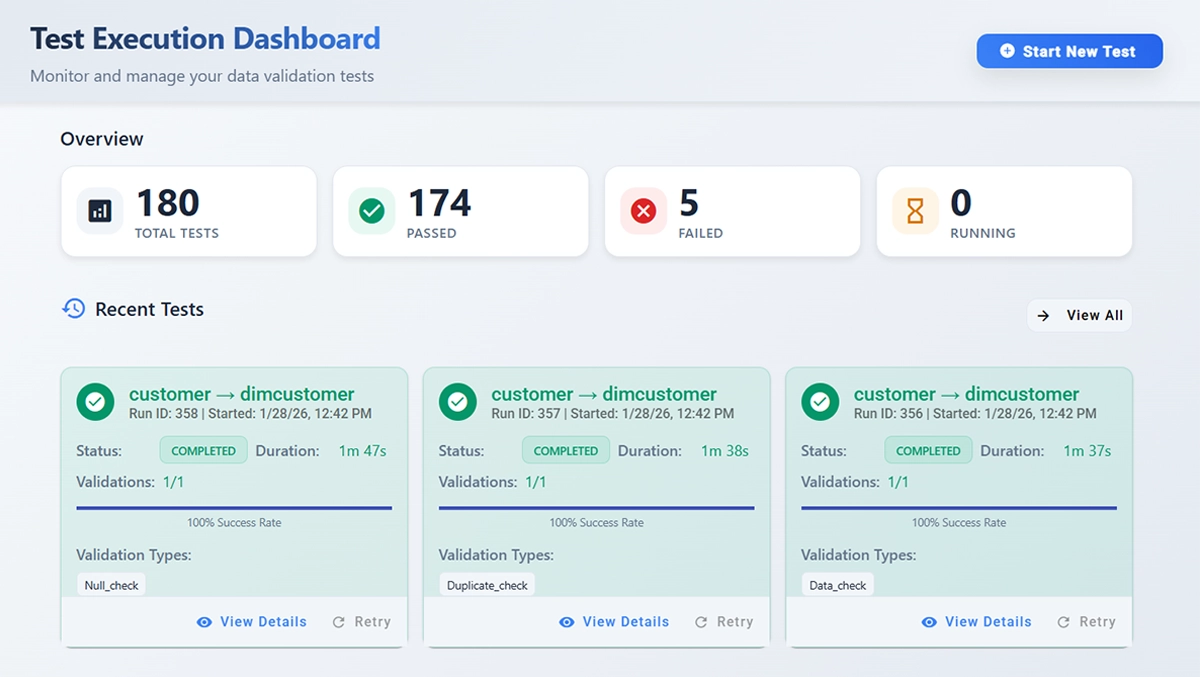
Why UI-Driven Test Automation Matters
UI-driven testing enables:
- Faster and more reliable testing
- Self-service test creation
- Reduced dependency on engineering teams
- Consistent and repeatable validations
Testing becomes scalable, governed, and easy to manage.
Real-World Use Cases
- Data migration testing
- Regression testing after schema changes
- Multi-client data platforms
- Compliance and audit validation
Final Thought
By combining UI-driven test definition with Microsoft Fabric Pipelines, organizations move from manual validation to automated data trust.
In modern data platforms, testing is not optional—it is automated.
Why this matters now: As Microsoft Fabric programs scale across domains and teams, automated testing becomes the control plane for reliable delivery—making regressions visible and governance measurable. The Test Automation Framework is one of the key frameworks of Evoke’s Microsoft Fabric Data Accelerator tool—helping teams standardize data testing, reduce manual effort, and ship changes with confidence.
Learn more to unlock what’s possible with Evoke’s Microsoft Fabric Data Accelerator: Operationalize UI-driven test definition and pipeline-orchestrated execution to cut validation cycles and strengthen audit readiness.