


Adoption of cloud ERP modernization in Europe has become more than a strategic initiative. With the European Union’s active promotion of cloud adoption to improve market competitiveness, scalability, compliance, and digital sovereignty, more and more enterprises are shifting to cloud modernization. In fact, a report shows that the cloud ERP market is projected to hit $176.93 billion by 2032.
However, many enterprises still depend heavily on legacy systems. A Forbes study found that a large group of companies still use legacy architecture, with 44% of mission-critical components, like storage, servers, and operating systems, nearing their end of life. This is due to the belief that legacy systems are more reliable for running high-stakes functions while ensuring complete data control. Additionally, the upfront cost of cloud modernization is high, and it risks unwanted disruption. This notion restricts European enterprises from realizing operational agility and innovation, which are critical to thriving in the contemporary hypercompetitive business environment.
The blog helps you understand why enterprises need to adopt cloud ERP modernization and how it enables business agility and innovation. It explores the potential challenges of its implementation and the best practices involved in navigating these problems to leverage digital transformation for optimal benefits.
Why Enterprises Need to Shift to Cloud ERP Modernization in Europe
Business agility, flexibility, and adaptability to both market and modern regulatory changes are critical competitive drivers for contemporary enterprises across Europe.
Legacy ERPs fall behind in meeting the evolving business demands. Their limitations in data integration, operational scalability, and rising maintenance costs impact operational efficiency and market responsiveness. This is why more enterprises are embracing Cloud ERP migration in Europe.
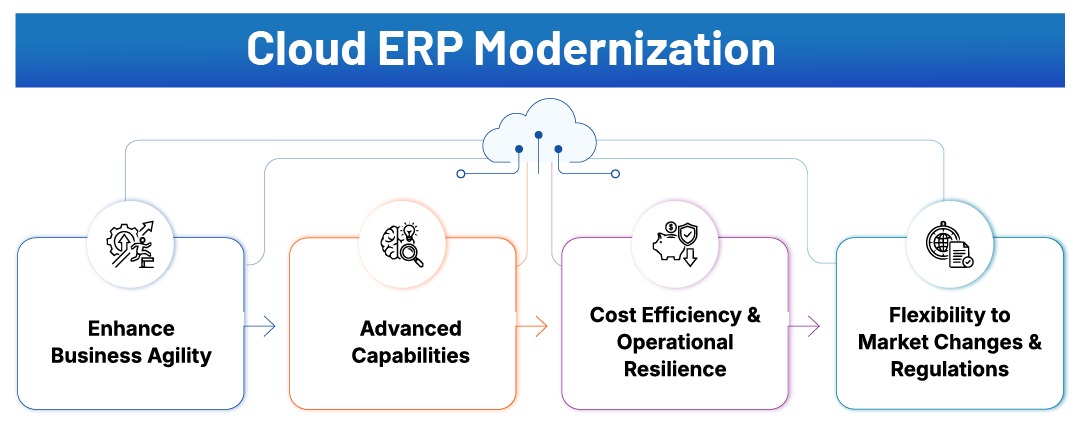
- Enhance business agility: Cloud modernization streamlines access to real-time data, provides demand-based operational scalability, and enables automated workflows. A unified cloud platform supports uninterrupted remote collaboration between teams, resulting in faster problem resolution and innovation.
- Cloud ERP thus makes a company’s environment more agile and helps it stay competitive amidst market changes. For instance, enterprises with cloud ERPs can quickly reflect tax changes in transactions or product rates with real-time updates and data synchronization.
- Advanced capabilities: Cloud-based ERPs offer advanced operational and integration capabilities. Their built-in AI/ML capabilities, along with analytics and automation tools, deliver smart, actionable insights and forecasts. Unlike legacy ERP systems, cloud ERPs seamlessly integrate with other workflow systems, including CRM, SCM, and other automation tools. This allows enterprises to support continuous innovation with minimal bottlenecks.
- Considering practical implementation, Evoke, for instance, helped a company transform its operational competence with Oracle’s advanced ERP solutions. Following the modernization, the company’s newly structured ERP environment became more reliable and scalable, enabling better control and visibility across financial processes.
- Cost efficiency and operational resilience: Cloud ERP modernization can help European enterprises make cost-effective operational strategies. Unlike heavy upfront investments in servers, hardware, and software licenses, businesses can select pay-as-you-go or subscription-based pricing models. Businesses can scale resources based on performance, workload, and business needs. This avoids unnecessary resource waste. Furthermore, automation streamlines operational resilience while eliminating the additional costs incurred due to manual labor and data entry errors.
- Flexible to market changes and regulations: As the EU market expands, businesses are increasingly focusing on regulatory mandates involving data sovereignty and accountability. Cloud ERP providers such as Oracle and Microsoft provide built-in compliance tools, real-time data analytics, and smart AI/ML capabilities. This helps businesses quickly adapt to evolving markets and regulations. For instance, Oracle Fusion Cloud ERP allows businesses to modify their policies based on EU regulations, ensuring seamless time-to-market and data sovereignty.
Challenges in Adopting Cloud ERP Modernization in Europe
Despite the benefits, adopting cloud ERP modernization has its share of challenges in Europe.
Some of the key obstacles include:
- Implementation complexity and cost management: Shifting to cloud ERP can be complex and expensive; the larger a business, the higher the costs. In fact, high cloud costs are a common concern. Data migration complexities and integration with on-premise systems, coupled with a lack of strategy and governance, risk cost overruns.
- Data security and compliance concerns: Ensuring data security and meeting regulations such as GDPR, the Data Act, DMA, and DSA are paramount in the European market. Companies have to store employee and financial data in the cloud, ensuring role-based data access, encryption, and audit. The cross-border operations and role-based access can further increase compliance and data security complications. This makes it difficult to comply with EU regulatory mandates.
- Resistance to change and adoption: A flexible cultural attitude is necessary to successfully embrace cloud ERP. In many cases, the unwillingness of the employees to learn the new system makes the modernization journey difficult.
Best Practices for Effective Implementation of Cloud ERP Modernization
Ensuring effective cloud ERP implementation contributes to operational resilience and sustainable scalability. The cloud integrations help businesses access real-time data, helpful in auditing and conforming with regulatory requirements. The data insights fuel better decision-making, whereas new technology updates support innovation and faster deployments, with minimal disruptions.
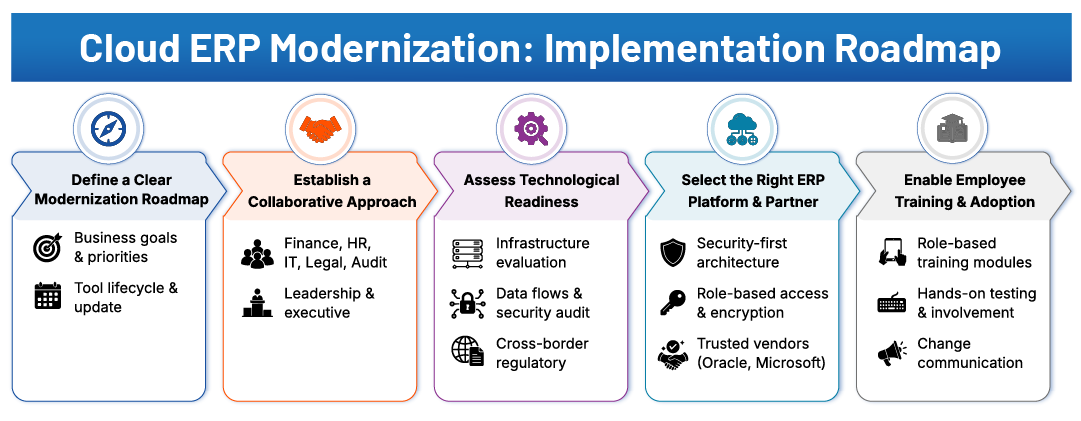
However, certain practices are crucial to successfully navigate through cloud ERP modernization challenges. These include:
- A clear cloud ERP modernization roadmap: Understand the business requirements and the end goals. Prioritize areas for modernization and assess the update frequency and support lifecycle of the selected tools, ensuring their alignment with business objectives.
- Establish a collaborative approach: The involvement of key stakeholders, such as finance, HR, IT, legal/audit, and end users, is crucial to supporting the change. Businesses need to actively engage leaders and executives to successfully materialize the technological transition.
- Determine technological readiness: Evaluate the existing technological infrastructure and identify possible vulnerabilities and security loopholes. Perform a thorough audit of processes and data flows, considering regulatory mandates, cross-border and national regulations, and trade rules.
- Select the correct cloud ERP provider and partner: Choose platforms with security-embedded architecture at every phase. Oracle, for instance, offers clearly defined role-based access and robust data encryption, ensuring data safety both in transit and at rest. Microsoft Defender offers multi-cloud data security capabilities, ensuring continuous protection during process management and deployment. Working with reliable partners such as Evoke Technologies also helps businesses to leverage the best of industry-specific cloud ERP solutions while maintaining cost-efficiency.
- Employee training for better user adoption: To tackle change resistance, empower employees with relevant training modules and discussions. Clearly communicate the need to undergo this digital transformation and its potential benefits. Actively involve employees in testing the new cloud ERP systems to increase their familiarity and confidence in using the tools.
As cloud ERP modernization gains traction in Europe, ensuring its successful implementation is crucial to realizing its optimum value. It enables enterprises not only to automate complex repetitive tasks but also to streamline cross-border collaboration, ensuring security and compliance at every level. Cloud ERP thus serves as a strategic enabler of business agility and innovation.
However, without a structured implementation plan, cloud ERP modernization initiatives risk business misalignment, integration complexities, cost overruns, and compliance breaches. Businesses need the right combination of expert professionals, approaches, and technology suites to map a realistic, requirement-based modernization roadmap.
This is where experienced service providers such as Evoke Technologies can help. We apply data-backed methodologies and cloud ERP solutions through a clearly defined implementation roadmap, enabling efficient and compliant cloud ERP modernization while aligning with each organization’s unique business needs.
Connect with Evoke experts to learn more.