


Manufacturing AI has moved decisively from experimentation to execution. However, as noted in Gartner’s research on Decision Intelligence and BCG’s analysis of AI at scale, most manufacturers continue to struggle with moving beyond pilots and embedding AI into daily shop floor decision-making.
While much of the market conversation still centers on computer vision, robotics, and predictive analytics, many manufacturers are discovering a more immediate opportunity: AI agents that operate directly on factory operations data. These Factory Operations AI Agents work alongside existing MES platforms to reduce friction, improve responsiveness, and scale decision-making on the shop floor—without requiring disruptive system replacements, an approach reinforced by both Forrester’s Industrial AI research in The Forrester Wave™: AI/ML Platforms (Forrester) and ARC Advisory Group’s guidance on next-generation Manufacturing Operations Management systems.
Why Factory Operations AI Agents Are Gaining Traction
Manufacturing leaders face a familiar set of constraints:
- Deeply embedded, aging MES platforms
- Fragmented data across historians, quality, and maintenance systems
- Shrinking pools of experienced operators and engineers
- Rising expectations for real-time operational responsiveness
According to IDC’s Future of Operations research, the challenge is no longer data availability but decision latency. Traditional dashboards improve visibility, yet they still rely on humans to interpret information and take action. As Forrester has noted, in its research on operational analytics and decision support, insight without embedded action limits operational impact—particularly in complex, fast-moving manufacturing environments.
Factory Operations AI Agents close this gap by acting as:
- Digital operations analysts
- Process-aware copilots for supervisors and engineers
- Autonomous monitors that escalate issues in context
Unlike generic chatbots, these agents are grounded in manufacturing semantics—orders, work centers, routings, downtime codes, quality holds, and labor constraints.
What Is a Factory Operations AI Agent?
A Factory Operations AI Agent is an AI-driven system that observes, reasons, and recommends actions based on live and historical shop floor data, operating within defined governance and SOP boundaries.
This approach aligns closely with Gartner’s Decision Intelligence framework, which emphasizes AI systems that actively support operational decisions rather than simply reporting outcomes
Key Characteristics:
- Context-Aware: It knows which machine is down, why it matters for the afternoon shipment, and which technician is available to fix it.
- Event-Driven: It does not wait for a weekly report; it reacts to the moment a quality deviation or downtime event occurs.
- Human-in-the-Loop: It is designed to augment people, not replace them. It gives supervisors a “head start” on solving problems rather than making autonomous decisions prematurely.
These agents work with MES, rather than replace it. They sit above and alongside it, extending its value with reasoning, orchestration, and natural-language interaction—an architecture consistently reinforced in the Gartner Market Guide for Manufacturing Execution Systems.
From MES to Fabric: A No-Rip-and-Replace Architecture
One of the most persistent misconceptions in manufacturing AI is that value requires replacing MES. Analyst consensus strongly disagrees.
The Role of MES
MES continues to serve as the system of record for:
- Dispatching and execution
- Data collection and validation
- Genealogy, traceability, and compliance
As Gartner’s MES Market Guide emphasizes, MES platforms are not designed for cross-system reasoning or AI-driven orchestration—and should not be forced into that role.
Why Microsoft Fabric Matters
Unified data platforms are increasingly viewed as foundational to operational AI. IDC’s manufacturing insights on unified intelligence platforms and the Forrester Wave™: Analytics and AI Platforms (Forrester) stress the need for a single intelligence layer capable of integrating MES, historian, quality, and maintenance data.
Microsoft Fabric fulfills this role by enabling:
- Unified operational data via OneLake
- Real-time analytics for event-driven shop floor monitoring
- Semantic models aligned to manufacturing concepts
- Copilot and agent frameworks for operational AI
In this architecture, MES remains the execution backbone, while Fabric becomes the intelligence layer—consistent with Gartner’s recommended approach to industrial analytics architectures.
High-Impact Use Cases for Factory Operations AI Agents
1. Production Exception Management
Research from BCG’s Factory of the Future program and McKinsey’s digital manufacturing studies on escaping pilot purgatory show that throughput losses are more often driven by recurring micro-stoppages and delayed responses than by major equipment failures.
Instead of supervisors scanning dashboards, AI agents:
- Monitor cycle times, downtime, and schedule adherence
- Detect abnormal patterns across lines and shifts
- Explain why production is at risk
- Recommend corrective actions based on historical outcomes
2. Shift Handover Intelligence
Shift handovers remain a chronic weak point in many plants. McKinsey research on the future of work in manufacturing identifies the loss of context between shifts and reliance on tribal knowledge as persistent sources of variability and quality risk.
Operations agents can:
- Summarize the previous shift in plain language
- Highlight unresolved issues and emerging risks
- Preserve institutional knowledge beyond individual operators
3. Quality Deviation Triage
When SPC limits are breached or defect rates spike, speed and context matter more than perfect root cause analysis. Forrester’s industrial AI research and ARC guidance emphasize AI-assisted triage rather than premature automation.
Agents can:
- Correlate defects with process parameters and materials
- Identify likely causes based on prior incidents
- Recommend containment actions aligned with quality SOPs
4. Maintenance Coordination
Rather than relying solely on predictive models, operations agents monitor chronic downtime patterns and coordinate maintenance actions in production context. According to IDC research on intelligent operations, context-aware coordination delivers more value than isolated predictive alerts.
Why Factory Operations AI Agents Outperform Dashboards
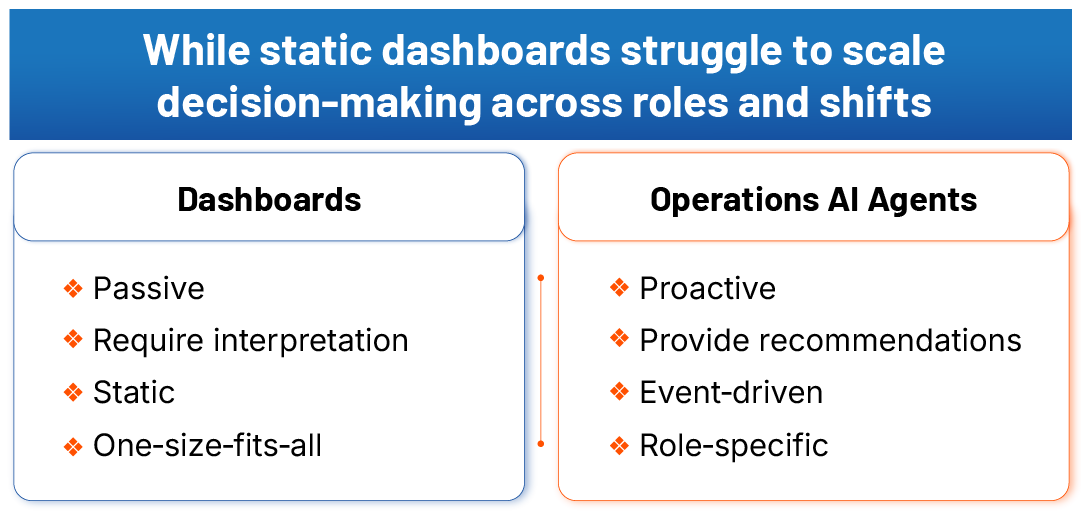
Dashboards explain what happened.
AI agents help decide what to do next.
As noted in both Gartner’s research on Decision Intelligence and Forrester’s analysis of why dashboards fail to drive decisions, static dashboards struggle to scale decision-making across roles and shifts in complex operations.
Organizational Readiness: The Real Constraint
Across multiple research and real-world examples, one conclusion is consistent: technology is rarely the limiting factor.
Common barriers include:
- Inconsistent MES data definitions
- Limited trust between IT and Operations
- Unclear decision rights for AI-assisted actions
- Fear of “black box” automation
This aligns with Gartner’s work on AI Trust, Risk, and Security Management (TRiSM).
Also, the reason why leading manufacturers begin with structured readiness assessments rather than isolated pilots.
Future of Manufacturing Factory Operations AI Agents
Factory Operations AI Agents represent a pragmatic, scalable entry point for AI on the shop floor. By augmenting—not replacing—MES and embedding intelligence directly into operational workflows, manufacturers can move beyond dashboards and pilot purgatory.
As emphasized across Gartner, Forrester, and IDC, the future of manufacturing AI lies in decision intelligence at scale, grounded in operations and designed for the people running them every day.
Evoke Technologies works with manufacturers to make Factory Operations AI Agents practical on the shop floor. By building on existing MES systems and data platforms like Microsoft Fabric, Evoke helps teams move quickly from ideas to working solutions that support real operational decisions—without major disruption.
Ready to move beyond pilots? Connect with us to explore how Factory Operations AI Agents can help your manufacturing.