


Build vs. Buy: A Strategic Playbook
The days of experimental pilot projects and flashy demos are over; today, it is all about plumbing. Enterprise boards and CXOs are not debating if AI can work anymore—they are focused on how to make it scale across the entire organization without breaking anything. Add that to today’s hyper‑competitive and rapidly evolving digital economy, investing in AI is no longer optional—it is foundational. It emphasizes that deploying AI successfully requires a strategic operating model that supports governance, cross-functional integration, and long-term value rather than fragmented experimentation. Gartner’s highlights that to successfully use AI, organizations need a clear plan that ensures proper management, teamwork across different departments, and lasting benefits instead of just trying out random ideas. But the path to operationalize AI at scale presents organizations with complex choices: build in‑house capabilities, adopt external services, or craft a hybrid model. Amid these crossroads, Global Capability Centers (GCCs)—sometimes called Global In‑House Centers (GICs)—are emerging as strategic engines that deliver AI innovation, governance, and operational excellence.
This blog unpacks AI Delivery Global Capability Centers with a focus on AI Engineering, offering practical guidance for executive leadership, especially COOs, CTOs, and Board members evaluating funding, governance, and capability strategy.
1. What is an AI Delivery Global Capability Centers?
A Global Capability Center for AI Engineering is a centralized, often globally distributed organizational unit designed to:
- Build and scale enterprise AI solutions
- Deliver cross‑domain innovation
- Host specialized engineering and operational teams
- Embed governance, compliance, and ethical risk management
Unlike traditional outsourcing or project‑based vendor models, GCCs enable companies to retain ownership over core AI assets—people, data, platforms, and intellectual property.
Key GCC Functions Include:
- End‑to‑end AI solution engineering
- Model development, deployment, and continuous monitoring
- Data platform and MLOps infrastructure
- AI governance, ethics, and compliance
- Cross‑functional incubation of AI innovations
2. Why AI Delivery Global Capability Centers Matter
As AI systems evolve beyond experimentation into full production, organizations struggle with:
- Integration challenges between AI and legacy systems
- Talent scarcity in data science and machine learning
- Operationalizing governance, compliance, and risk controls
- Scaling reliable deployment across business units
A well‑structured AI Delivery GCC addresses these bottlenecks by centralizing expertise and building repeatable engineering lifecycles. This delivers value in three major dimensions:
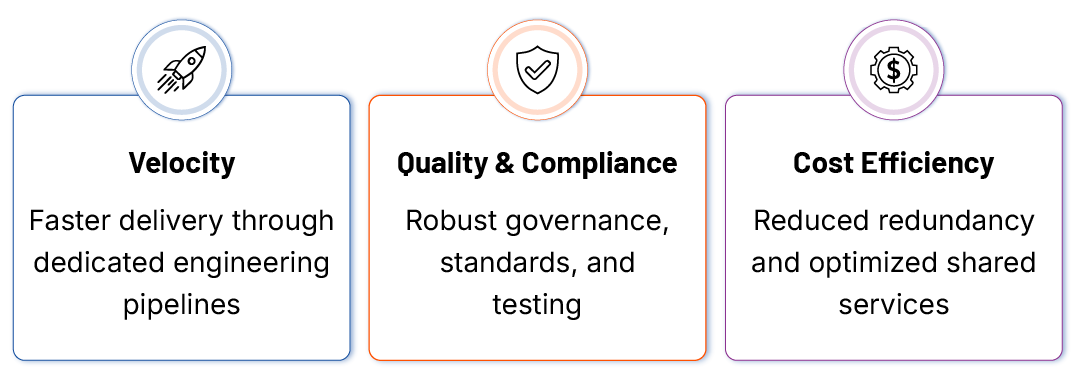
3. Build vs. Buy: The Strategic Decision Framework for AI Delivery Global Capability Centers
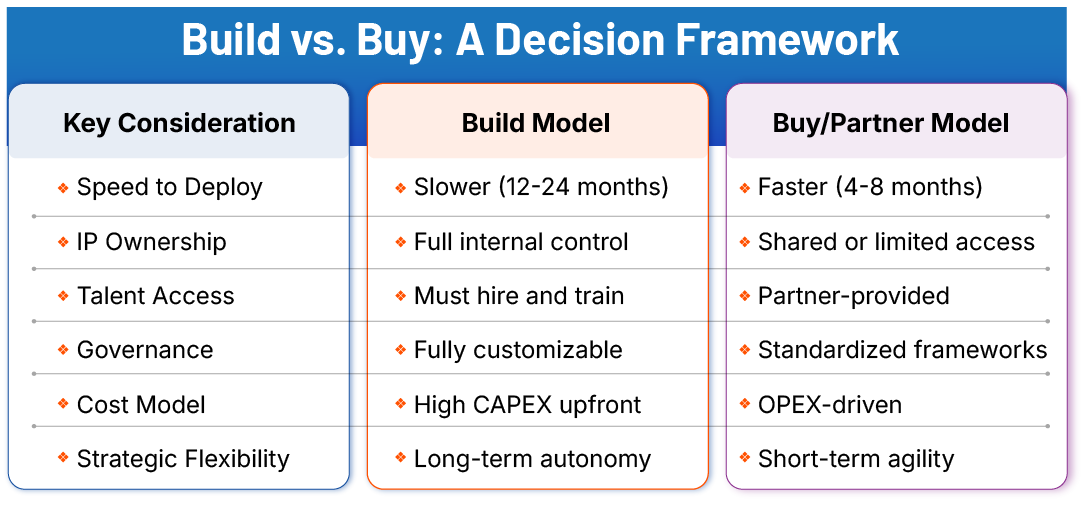
Gartner’s expert analysis on AI deployment explicitly recommends considering a build, buy, or blend strategy. When it comes to establishing AI engineering capacity, leadership often debates between:
Build: Invest in a GCC
- Ownership of IP and processes
- Control over talent and institutional knowledge
- Tailored engineering workflows
- Stronger long‑term cost benefits
But, building an AI Delivery Global Capability Center requires upfront investment—real estate, leadership hiring, infrastructure, training, and multi‑year commitments.
Buy: Outsource or Partner
- Immediate access to skills and tools
- Shorter time to initial results
- Lower initial investment
Downsides of buying:
- Vendor lock‑in
- Limited influence over governance or strategic roadmaps
- Loss of internal capability growth
Forrester’s research on build-vs-buy strategy in the AI era highlights the importance of balancing vendor solutions with internal capabilities to deliver meaningful outcomes and avoid tool sprawl or vendor lock-in.
4. When does building an AI Delivery Global Capability Centers Makes Strategic Sense
A GCC should be seriously considered when:
a. You Depend on AI for Core Competitive Advantage
If AI directly influences your product roadmap, customer experience, or business model differentiation, retaining engineering ownership is essential.
b. You Need Scale and Repeatability
Ad hoc engagements with vendors can work for pilots—but fail to deliver repeatable, maintainable, and secure production deployments across regions, products, and teams.
c. You Must Govern Responsible AI Internally
External partners may not align with your risk appetite, compliance frameworks, or ethical standards. A GCC is better positioned to enforce enterprise‑wide governance.
d. You Want to Build Strategic Talent Pools
AI is a talent war. A GCC attracts and retains multidisciplinary engineers, product managers, and data scientists under a single umbrella.
5. When Outsourcing or Buying Expertise Makes Sense
In contrast, Buy may be the right early choice if:
- You are in proof‑of‑concept (POC) phases
- Your organization requires episodic or project‑level AI work
- You lack initial leadership capacity to seed a GCC
- Your investment horizon is short
- You want to augment internal teams rather than replace them
For many organizations, Build and Buy are not mutually exclusive; hybrid models can leverage best‑in‑class partners while maturing an internal GCC team.
6. A Practical AI Delivery Global Capability Centers Strategy Roadmap
The following phases are recommended for COOs and CTOs to evaluate and operationalize a GCC strategy:
- Phase 1: Alignment & Vision Setting
- Phase 2: Financial & Funding Model
- Phase 3: Talent Strategy and Organizational Design
- Phase 4: Technical Platforms & Engineering Practices
- Phase 5: Governance, Risk & Compliance (GRC)
- Phase 6: Cross‑Functional Adoption & Change Management
7. Funding AI Engineering GCCs: A Board’s Perspective
Boards and cross‑industry funding committees should evaluate GCC investments through several lenses:
Strategic Value
Is the GCC tied to high‑impact, strategic outcomes (e.g., customer experience, cost reduction, new revenue)?
Risk Mitigation
Does the GCC strengthen risk controls for AI rollout, ethics, and compliance?
Long‑Term Competitiveness
Does internal capability reduce dependency on external firms and rising vendor costs?
Talent Permanence
Does the GCC attract and retain top talent that contributes to organizational IP?
Measurable KPIs
Boards should insist on well‑defined adoption, quality, and ROI indicators, such as:
- Time to production
- Model performance improvements
- Cost per deployment cycle
- Internal stakeholder satisfaction
8. Common Pitfalls and How to Avoid Them
Even with the best intent, GCC initiatives can falter. Leaders should watch for:
Unclear Objectives
Without precise goals, GCCs become cost centers instead of strategic engines.
Remedy: Set SMART objectives (Specific, Measurable, Achievable, Relevant, Time‑bound).
Overly Centralized Governance
Excessive control slows delivery and alienates business units.
Remedy: Balance governance with delegation through federated practices.
Talent Silos
AI is interdisciplinary. Siloed teams create bottlenecks.
Remedy: Build cross‑functional pods with shared accountability.
Lack of Adoption
Technical deliverables alone do not create value.
Remedy: Embed change agents and measure downstream business impact.
9. Hosting a GCC Strategy Workshop: A Practical Template
To accelerate GCC readiness, run an executive GCC Strategy Workshop that includes:
Session 1: Vision, Outcomes & Metrics
Participants: Board sponsors, CEO/COO, CTO
Outcome: Consensus on purpose, KPIs, and governance model
Session 2: Capability Mapping
Participants: Technical leaders, architects
Outcome: Gap analysis of current vs. required capabilities
Session 3: Funding & Risk Modeling
Participants: CFO, risk, compliance
Outcome: Funding roadmap and risk mitigation plan
Session 4: Operating Model
Participants: HR, delivery leads
Outcome: Org structure, talent sourcing, and performance management
Session 5: Execution Plan
Participants: All stakeholders
Outcome: 90‑day launch plan with milestones and owners
Future of AI Delivery Global Capability Centers as Strategic Engines
Global Capability Centers are not a fad—they are a strategic asset for organizations committed to delivering AI on an enterprise scale. The choice between building versus buying is not binary: hybrid models often deliver early velocity and long‑term ownership.
For COOs, CTOs, and Boards, the real opportunity lies in designing GCCs that:
- Embed AI engineering excellence
- Enable repeatable, governed delivery pipelines
- Attract and retain world‑class talent
- Connect technology investments to measurable business value
Today’s AI revolution rewards organizations that combine vision, governance, and execution. By taking a thoughtful, well‑funded, and strategically aligned approach to AI Delivery GCCs, enterprises can build enduring capability—and sustained competitive advantage.
Businesses looking to accelerate AI Delivery Global Capability Centers can benefit from partnering with experienced technology companies that specialize in enterprise AI engineering. Evoke Technologies helps enterprises move beyond pilots to fully operational, scalable AI systems. Partnering with Evoke, organizations can accelerate GCC launch—turning AI investment into strategic advantage.