


We all have likely experienced the rapid adoption of artificial intelligence usage at work or are at least intrigued by its infiltration into our daily workflows. AI has become a staple in modern workplaces, but not always in the ways organizations plan or approve. With this rapid growth comes a silent, scary security risk we need to address: Shadow AI. Let us explore what Shadow AI is, why it is causing quite a stir, the risks involved, and how Microsoft Agent 365 can help you keep things under control, along with some real-world examples of how shadow AI affects organizations. Let us dive in!
What Exactly Is Shadow AI?
Picture this: You are at work, trying to finish a report or code faster, and you turn to ChatGPT or some other AI tool for help. But wait, did you inform your IT team? Was it approved? If not, then that is Shadow AI in action. According to IBM, Shadow AI is when employees use AI tools, platforms, or models inside an organization without the IT, data governance, or security folks being in the loop. Effective Shadow AI governance begins with understanding these unauthorized tools and activities.
This could look like:
- Sneaking in ChatGPT, Claude, Gemini, or open-source language models without permission.
- Teams plugging AI APIs into their workflows without any paperwork.
- That “bring-your-own-AI” vibe, like using free online code generators or data analyzers.
- Running local AI models (think open-source stuff like LLaMA) on your own machine, dodging corporate rules.
- Whipping up automated scripts or agents without a security check.
- It is basically the AI version of shadow IT, but with way bigger stakes. Shadow AI does not just disrupt your network—it can spill data, sway decisions, leak intellectual property, and throw compliance out of the window. Strong Shadow AI governance is essential to mitigate these risks.
Why Is Shadow AI Spreading Like Wildfire?
Essentially Shadow AI is not some evil plot; rather, it often involves people trying to get work done. Gartner predicts nearly 40% of breaches will result from Shadow AI. Here is why it is growing so fast:
- AI Tools Are Just Too Handy and Powerful
Knowledge workers love using AI for writing, coding, analyzing data, researching, or chatting with customers. If the official tools are inadequate or the resources are nonexistent, employees end up using what they can find. - Innovation Outruns the Rules
AI evolves at lightning speed—new tools drop weekly. Many companies are playing catch-up, without solid policies or strong Shadow AI governance practices. - The Push for Productivity
Deadlines loom, and performance reviews are coming up. Workers turn to AI to boost efficiency, even if no one has instructed them how to do it safely. - Not Enough Training or Awareness
Honestly, a lot of employees do not realize that popping data into an external AI tool could violate privacy or security rules. It is not always obvious!
Real-World Examples of Shadow AI
To make this relatable, let us look at some scenarios:
- Dumping Sensitive Data into Chatbots
In 2023 engineers of a consumer electronics giant uploaded proprietary source code to a public LLM which inadvertently was leaked to a third party as well as used to train the bot leading to an internal ban on usage of the tool. - Unofficial AI Helpers in Customer Service
An airline’s unmonitored chatbot gave false information to a customer on a certain policy, which led to a lawsuit and the court ruling in favor of the customer. - AI-Driven Decisions Without Checks
A big consultant firm generated reports using AI without checks for the Australian government, which turned out to be fabricated and had many inaccuracies, which resulted in reputational and financial damages. In another case involving a Canadian healthcare report, the firm was again found using AI without checks, resulting in similar damages. - Local LLMs on Personal Machines
A supply chain manager used an unauthorized AI tool to optimize inventory, which exposed the company’s systems to hackers, leading to a malware attack that crippled the company’s logistics.
The above cases highlight why enterprises urgently need Shadow AI governance.
The Risks: Why Should We Care?
As mentioned in this report from Gartner, Shadow AI comes with serious downsides. Here is the rundown:
- Data Privacy Breaches
Unapproved tools might hoard, log, or train on your data, violating laws like GDPR, HIPAA, or CCPA. In industries like banking or healthcare, such practices are a big no-no. This makes Shadow AI governance crucial for compliance. - Intellectual Property Leaks
Imagine your company’s secret code or designs ending up in some external model. Not cool. - Compliance and Legal Headaches
Using undocumented systems can invite fines, audits, or lawsuits. No guardrails mean no safety net. - Security Holes
These tools could have malware, prompt injection risks, or expose credentials. It is like leaving the back door unlocked. - Biased or Wrong Outputs
Unofficial AI for decisions might spit out inaccurate, discriminatory, or untraceable results. Hard to fix if you cannot explain it. - No Accountability or Audits
In regulated fields, you need to track and explain AI outcomes. Shadow AI makes that impossible.
In short, Shadow AI gives you all the risk of AI innovation with none of the control.
Shadow AI vs. Shadow IT: What is the Difference?
To put it in perspective, let us compare Shadow AI to good old shadow IT:
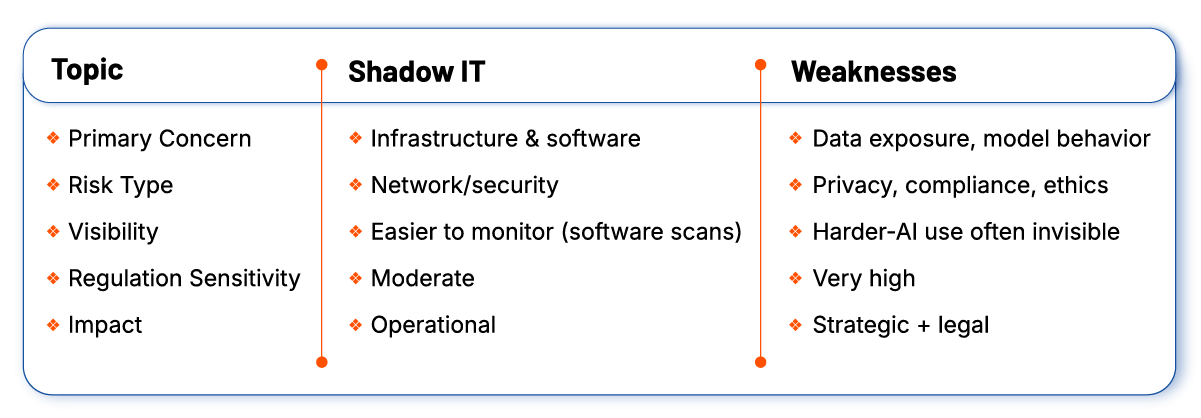
Shadow AI takes shadow IT’s problems and cranks them up, adding ethical and data twists. This is why many organizations are shifting from traditional IT governance to comprehensive Shadow AI governance strategies.
Introducing Microsoft Agent 365: Your AI Radar and Control Panel
Microsoft Agent 365 is built to solve this problem by bringing order, visibility, and control to your chaotic AI ecosystem. Think of it as the unified hub for managing every agent, from a simple Copilot automation to a complex, custom GenAI workflow.
Here is how Microsoft Agent 365 helps you bring Shadow AI into the light and strengthen your Shadow AI governance framework:
- Find the Agents, You Never Knew You Had: Agent 365 acts like a discovery tool, sniffing out all agents interacting with your Microsoft 365 environment—even the ones built entirely outside IT’s view. “You can’t govern what you can’t see!”
- Enforce the Rules, Automatically: You get centralized policy controls to enforce non-negotiables:
- Who can access what data.
- Which models are approved for use.
- Mandatory activity logging and security settings.
- Result: Every agent adheres to corporate standards, period.
- Real-Time Behavior Watch: It provides continuous oversight: who is doing what, what data is being used, and which dependencies exist. You can quickly spot anomalies or prevent harmful actions before they cause a crisis.
- Lock Down External Connections: It manages how agents integrate with outside models and APIs, shutting down unauthorized connections to untrusted endpoints—a primary vector for Shadow AI risk.
- Build Trust with Transparency: Detailed audit trails and consistent reporting mean you can easily meet compliance needs and build stakeholder trust in your AI systems.
Secure AI From Day One: Simple Steps to Take
Do not wait for a breach. You can proactively prevent Shadow AI with a few smart moves:
- Establish a Governance Framework: Get clear rules and policies in place early on in your AI journey.
- Deploy Agent 365: Use it to gain immediate, full visibility across your entire environment.
- Educate and Empower: Train your teams on the risks of unapproved agents, but also…
- Encourage Innovation with Guardrails: Give teams approved, secure channels (like Copilot Studio) to build and experiment so that they need not go rogue.
- Monitor Forever: AI governance is not a one-time setup. Maintain continuous monitoring and lifecycle management.
Each of these steps strengthens your organization’s Shadow AI governance maturity
Time to Take Control
Shadow AI is not driven by malice but rather it is driven by a desire to work smarter. Without governance, this desire opens the door to security incidents, compliance failures, reputation, and costly operational errors.
Microsoft Agent 365 gives you the confidence to form the backbone of effective Shadow AI governance to unlock AI capabilities without inheriting crippling risk.
Ready to build strong, secure AI governance from the start—or need a partner to help you uncover the shadow AI you already have?
Contact Evoke Technologies today to secure your AI ecosystem and unlock AI capabilities safely and responsibly.