


As the European Union moves ahead with the Digital Product Passport (DPP) under its Circular Economy Action Plan, manufacturers are facing a mix of regulatory pressure and strategic opportunity. This is driving the interest in the AI-Driven Digital Product Passport for manufacturing. Combining AI-driven quality control with DPP requirements allows for smarter compliance, better product output, and more stable supply chains—particularly within Germany’s sophisticated industrial landscape. This blog explores how Manufacturing AI and Industry 4.0 work together to meet DPP standards while delivering real business value.
1. Context: The Meeting of EU DPP, Industry 4.0, and the AI-Driven Digital Product Passport for Manufacturing
The EU Digital Product Passport requires digital records for a product’s entire lifecycle, covering materials, parts, and sustainability metrics. Leading to the foundation of an AI-Driven Digital Product Passport. For those on the factory floor, this means:
- DPP is more than a reporting requirement—it is a reason to finally digitize operations.
- AI strengthens traceability and quality checks across the production line.
- Existing Industry 4.0 setups (IoT, MES, digital twins) provide the data “fuel” that AI needs to work.
Digital product passports “create a rich digital identity for products throughout their lifecycle” according to Gartner research. Innovation Insight: Digital Product Passport — Unlocking Value Beyond Compliance (Gartner)
Key Drivers in the EU and Germany
- Increasingly strict compliance rules from EU authorities.
- Circular economy mandates that require clear data on recycling and material origins.
- Broad adoption of Smart Factory tech among German SMEs and large-scale OEMs.
2. Common Challenges for Manufacturing Leaders
CIOs and Quality Heads in the EU frequently point to several recurring obstacles:
-
Fragmented Data Landscapes
Legacy systems like ERP, PLM, and SCADA often use different formats. This leaves quality and traceability data trapped in disconnected silos. -
Shifting Regulations
The exact rules for the DPP are still being finalized for different product groups, making it difficult to build long-term plans without risking operational hiccups. Industry standards are still emerging and fragmented, as noted by Forrester in its analysis of Digital Product Passport standardization. Forrester: A Digital Product Passport Needs More Standardization -
Scale and Logistics
Managing a massive number of SKUs across multi-tier, global supply chains is incredibly complex, especially when suppliers have varying levels of digital maturity. -
Reactive Processes
Too many plants still rely on manual checks or react to defects after they have already happened, leading to slow root-cause analysis.
3. How AI Supports DPP-Ready Quality and Traceability
This is the operational core of the AI-Driven Digital Product Passport for Manufacturing. AI tools provide the specific capabilities needed for both high-end manufacturing and DPP compliance:
-
Intelligent Traceability
AI models can link sensor data, barcodes, and production logs to track parts through every stage. This automatically builds the data threads required for DPP reports. -
Predicting Defects
Using computer vision and machine learning, systems can spot anomalies in real time. This cuts down on scrap and ensures more products are right the first time. -
Better Root-Cause Analysis
AI identifies patterns across different sources—like equipment logs and environmental sensors— to find out why a problem happened, speeding up corrective actions. -
Automated Compliance
The system can check product data against DPP requirements in real time, flagging anything that is missing or inconsistent before it becomes a legal issue.
But strategy gaps persist; a Gartner survey shows many manufacturers are not yet aligned on AI automation priorities. Gartner: Manufacturing Strategy & AI Integration Survey
4. A Blueprint for AI and DPP Architecture
Core Layers
- Data Intake: Connecting IoT, PLC, ERP, and MES systems to create a single, clean source of material and batch data.
- AI Engines: Using graph analytics for traceability and machine learning for anomaly detection.
- DPP Interface: Translating data into standardized formats (like GS1 or W3C) for regulators, recyclers, and customers.
- Dashboards: Visualizing quality KPIs and compliance status so managers can act on contextual alerts immediately.
5. ROI and Business Impact
A Blueprint for AI and DPP Architecture supporting the AI-Driven Digital Product Passport for Manufacturing. Real-world AI projects in this space tend to show clear, measurable results:
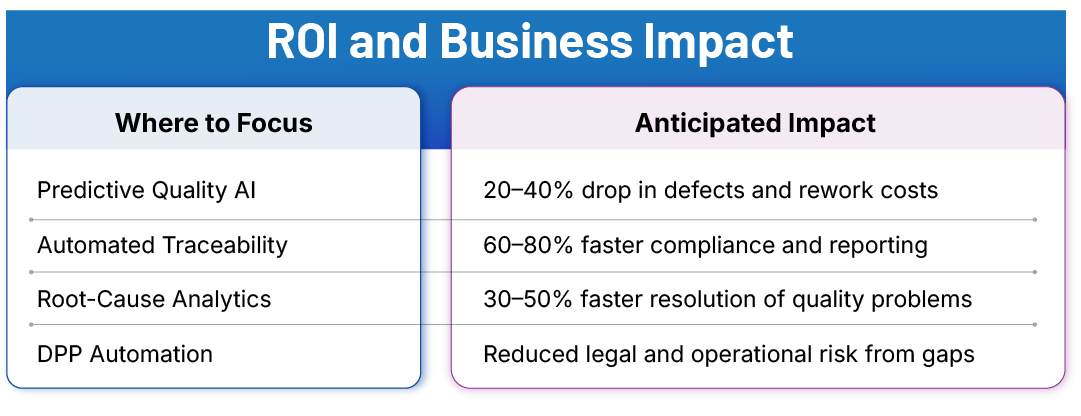
However, BCG notes that most manufacturers struggle to scale AI despite strong planning intentions. BCG: Shaking Up the Factory Floor with Digital and AI
Note: Results depend on the existing digital maturity of the plant.
6. Focus on Germany and the EU
Germany’s industrial base—from automotive to chemicals—is perfectly placed to use AI for DPP:
- The German Mittelstand is already moving from AI pilots to full-scale use in quality and maintenance.
- National strategies and EU funding are actively supporting smart factory transitions.
- Cross-border supply chains are starting to benefit from shared, digital traceability standards.
7. The Implementation Roadmap
A phased approach helps manage the transition without overwhelming the team:
- Phase 1: Readiness – Map out current data flows and find the gaps in your traceability.
- Phase 2: Proof of Value – Run a pilot in a high-impact area, like visual inspection, to prove the AI works.
- Phase 3: Scale – Move the AI models to other lines and standardize your data governance.
- Phase 4: Automation – Fully integrate the AI with digital passports for continuous, hands-off reporting.
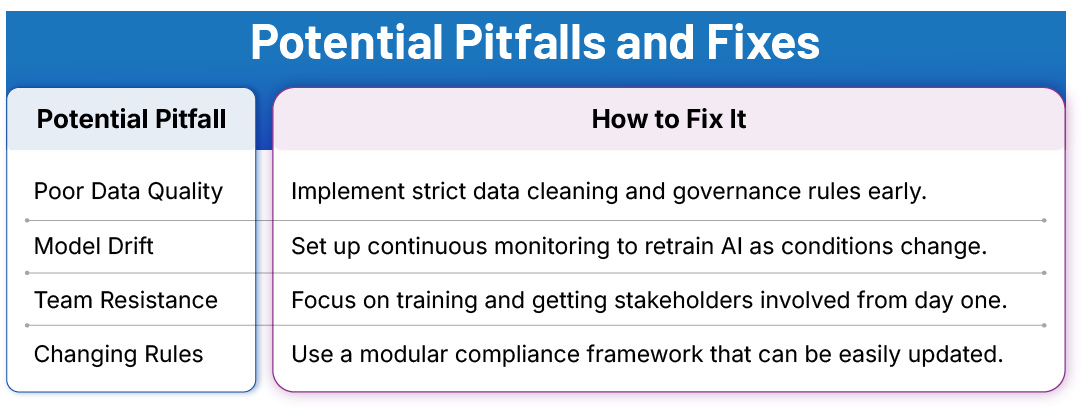
8. Potential Pitfalls and Fixes
9. Conclusion
Manufacturers that lean into AI-driven quality and traceability now will do more than just satisfy EU regulators. They will gain a massive competitive edge through better transparency and more resilient operations. For Germany and the wider EU, this shift is the next logical step towards a smarter, more sustainable industrial future. This is the long-term value of the AI-Driven Digital Product Passport for Manufacturing.
Making this transition requires scalable AI, interoperable data platforms, and Industry 4.0–ready architectures. Evoke Technologies helps manufacturers operationalize these capabilities—turning the AI-Driven Digital Product Passport for Manufacturing into a practical, scalable reality. Contact us now.