
AI‑Orchestrated ExtJS to React Modernization for a Regulated Pharmaceutical Enterprise

Case Study Details:
 Industry
Pharmaceutical & Clinical Trial
Industry
Pharmaceutical & Clinical Trial
 Region
Global
Region
Global
 Technology
Agent Skills · AI Multi‑Agent Orchestration · React 18 · ExtJS 7.6 · AG Grid · TanStack Query · WebSockets (STOMP/SockJS) · TypeScript Strict Mode
Technology
Agent Skills · AI Multi‑Agent Orchestration · React 18 · ExtJS 7.6 · AG Grid · TanStack Query · WebSockets (STOMP/SockJS) · TypeScript Strict Mode
The Challenge
For a mission‑critical pharmaceutical BPM platform modernizing two large, production‑active ExtJS 7.6 applications became an urgent necessity.
The platform supported clinical trial approvals, patient data reporting, and regulatory submissions, where every action required immutable audit trails, strict PHI protection, and regulatory‑grade compliance guarantees.
However, the modernization program faced several high‑risk and systemic obstacles:
- 152 ExtJS source files across 87,000+ lines of legacy code, built over years using complex MVVM patterns.
- Each module consisted of multiple numbered MVVM variants, where only the highest version was canonical—requiring precise analysis before any migration.
- Zero downtime requirement: ExtJS and React had to coexist in production using the Strangler Fig pattern, with route‑by‑route cutover.
- Pharmaceutical compliance constraints:
- Immutable, append‑only audit trails
- Double‑confirmation workflows for recalls
- Confirm‑before‑send email enforcement
- Absolute prohibition of PHI exposure in logs, URLs, or errors
- Real‑time BPM task queues using STOMP over SockJS demanded careful lifecycle management to avoid connection leaks and frozen approval queues.
- Dynamic, runtime‑driven forms stored in MongoDB required schema generation at runtime, not static UI rewrites.
The complexity, compliance sensitivity, and production criticality of the system made traditional UI migration approaches unsuitable.
A compliance‑first, parallelized, AI‑driven modernization model was required.
Evoke’s Approach
Evoke Technologies designed and deployed a 12‑agent autonomous AI migration system powered by Anthropic Claude, purpose‑built for enterprise‑grade ExtJS‑to‑React modernization under pharmaceutical compliance constraints.
Multi‑Agent ExtJS Analysis & React Transformation
Migration was executed through a 4‑tier agent architecture, where each AI agent owned a clearly defined, non‑overlapping responsibility:
- ExtJS MVVM deep analysis across all numbered variants
- Business‑rule extraction and API contract reconstruction
- React 18 + TypeScript strict‑mode code generation
- State migration from ExtJS Stores to TanStack Query + Zustand
- AG Grid server‑side pagination, bulk actions, and immutable audit grids
- Runtime Zod schema generation for MongoDB‑driven dynamic forms
This ensured semantic‑level migration, not just UI translation.
Parallel Wave Execution Model
Each sprint was decomposed into six coordinated execution waves:
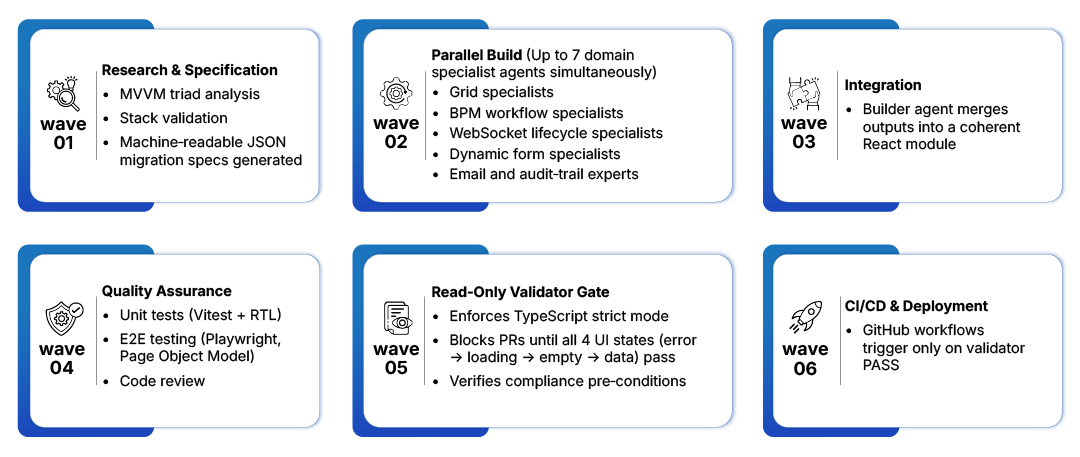
This parallelization compressed timelines that would otherwise take years using sequential developer handoffs.
Compliance‑First Domain Engineering
Compliance was embedded before any code was written, not reviewed afterward:
- Dedicated domain agents enforced:
- PHI handling rules
- BPM task lifecycle integrity
- Role‑based action rendering
- PDR recall double‑confirmation with mandatory reason fields
- Accessibility (WCAG 2.1 AA) was built‑in, not retrofitted.
- TypeScript strict mode enforced system‑wide — zero any usage permitted.
Continuous Learning Through Skill Libraries
The system improved with every migrated module:
- 40+ persistent skill libraries captured:
- ExtJS MVVM patterns
- React migration anti‑patterns
- Pharmaceutical compliance rules
- AG Grid server‑side best practices
- BPM workflow state machines
- JSON migration specs ensured full traceability from legacy ExtJS source to React output.
- Knowledge that once lived only with senior developers became institutional, reusable assets.
The Outcomes
| Metric | Before AI Modernization | After AI Modernization |
|---|---|---|
| Migration throughput | Sequential, manual rewrites | 6–8× parallel agent execution per sprint |
| Compliance assurance | Manual reviews, error-prone | Systematic, agent-enforced pre-conditions |
| UI state coverage | Often incomplete | 100% enforcement of all 4 UI states |
| Stack consistency | Drift-prone at scale | Locked, validator-enforced stack |
| Test coverage | Variable, often skipped | 80%+ unit + full E2E mandated |
| Institutional knowledge | Siloed with individuals | Codified in 40+ skill libraries |
| Production disruption | High migration risk | Zero downtime Strangler Fig cutover |
The organization now operates a repeatable, scalable, AI‑first modernization pipeline capable of transforming regulated enterprise applications without compromising compliance, performance, or production stability.


