


Complex manufacturing problems need advanced, data-driven solutions. This has positioned smart manufacturing and Industry 4.0 at center stage. Considering the hyper-competitive global market, the economic volatility, growing operational costs, and EU compliance requirements, Polish enterprises need to rethink how to scale, enhance resilience, and upgrade manufacturing operations.
A recent market report highlights that the current market for Poland’s smart manufacturing and Industry 4.0 is worth USD 9 billion. This shows that enterprises are increasingly utilizing smart manufacturing and Industry 4.0 initiatives as a powerful strategic lever to modernize production systems and improve value chains. Smart manufacturing supports the integration of IoT sensors, data, AI tools, and cybersecurity solutions. This enables Polish manufacturers to simplify operations and adapt more rapidly to both market changes and operational threats.
Yet, despite the potential, adoption remains inconsistent across Polish enterprises due to factors including unclear ROI, legacy operational systems, skills gaps, external risks, financial limitations, and inefficient implementation methods. These challenges limit manufacturing and Industry 4.0 initiatives from moving beyond the pilot phase.
This blog outlines the current state of smart manufacturing, the key challenges restricting it, and how a structured strategic roadmap can help Polish enterprises successfully convert Industry 4.0 into tangible business outcomes.
The Current Condition of Smart Manufacturing and Industry 4.0 in Polish Enterprises
Economic and sector-specific needs primarily drive the adoption of smart manufacturing in Poland. Leading manufacturers are investing heavily in IIoT and data analytics solutions to boost production velocity and quality in Polish factories. The transformation drive is dominant in cities such as Kraków, Warsaw, and Wrocław. The concentration of research centers on technology innovation further facilitates smart manufacturing and Industry 4.0 technologies in these regions.
On the other hand, SMEs, despite their willingness to invest, are reluctant due to uncertain ROI, perceived high costs, and a lack of strategic expertise. In fact, a recent report finds that only 65% of Polish firms have adopted digital technology.
The Challenges Limiting Smart Manufacturing and Industry 4.0
Despite the high ambition for smart manufacturing and Industry 4.0 in Poland, many enterprises are hitting a ‘digital ceiling.’ The challenge lies not only in technology costs but also in interoperability gaps between traditional systems and modern platforms.
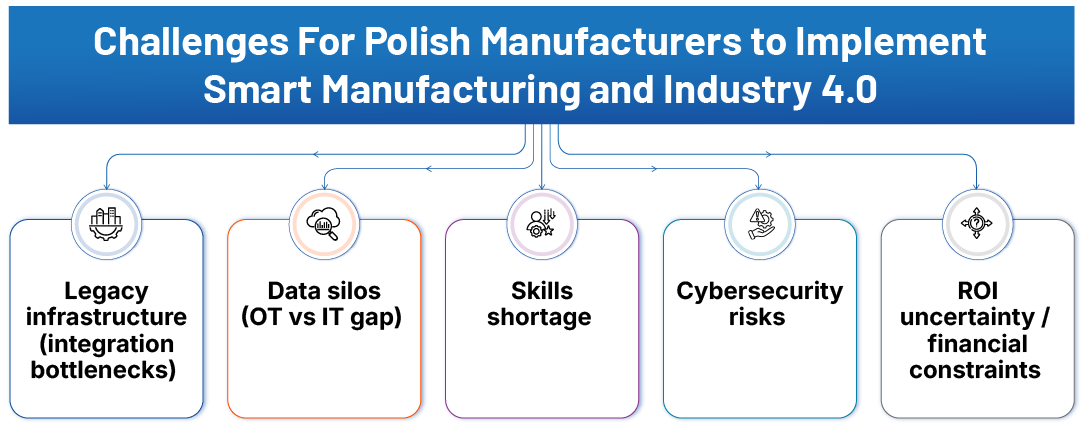
Some of the persisting challenges include:
- Outdated processes and legacy infrastructure: Most Polish companies still depend on legacy systems for high-value functions. While they are built for reliability, they cannot scale to meet demands effectively. Moreover, their distinct configurations complicate integration with modern technologies such as cloud, robotics, and AI.
- Data silos and poor real-time visibility: Despite the increasing adoption of IIoT (Industrial Internet of Things) in shop floors, the majority of Polish enterprises still operate with siloed data. Real-time data flow from the shop floor (OT) to the executive office (IT) is frequently absent.
- Shortage of skilled workforce: A Poland Digital Economy report mentions that one of the major challenges of achieving smart manufacturing and Industry 4.0 transformation in Poland is a dearth of skilled professionals. According to Poland’s 2025 Digital Decade Report, the share of ICT specialists’ employment has increased from 4.3% to 4.5%. However, the percentage still falls below the EU average (5%). A lack of digital training programs and courses, along with resistance to change, are reasons for the slow adoption of advanced technologies by Polish enterprises.
- Cybersecurity threats: Another major obstacle is cybersecurity and compliance concerns in the manufacturing sector, especially in connected shop-floor environments. Recently, the sector has seen a 30% increase in cybersecurity incidents, accentuating the need for stringent security measures.
An End-to-end Industry 4.0 implementation Roadmap
Polish enterprises need a business-focused and phased strategic approach to successfully execute smart manufacturing transformation. The strategy needs to balance operational readiness and technological vision.
Instead of a radical technological overhaul, Polish enterprises can benefit from a phased, problem-specific roadmap that delivers measurable results at each stage.
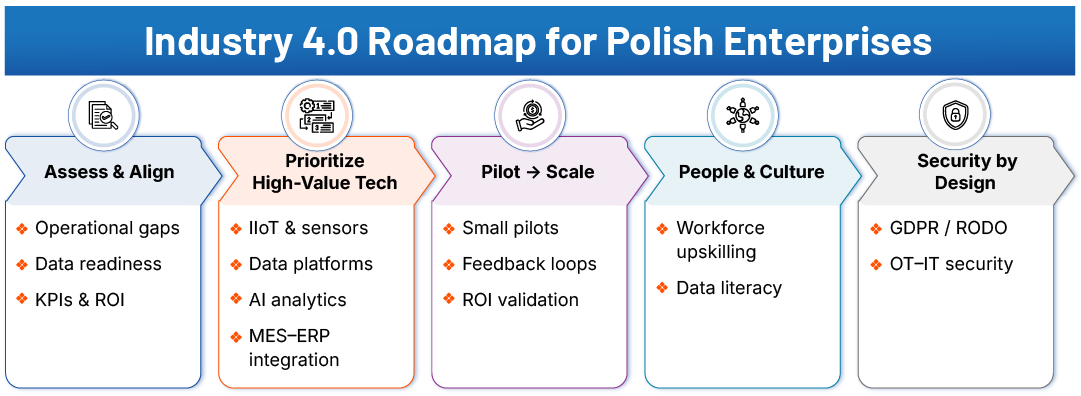
1. Determine the operational gaps: Assess current operational hindrances, machine health, system compatibility, asset downtime, and data flow across operational systems. Evaluate the data readiness of the systems and potential risks. Align the technology transformation with the business value and set clear objectives and KPI metrics to measure tangible outcomes.
2. Prioritize high-value technologies: Consider the initial investments on technologies that give immediate tangible value. The technologies include:
- Sensors and IIoT Gateways: Help link legacy systems and deliver real-time operational data
- Data engineering platforms: Collect, store, and analyze production data
- AI-powered analytics: This enables predictive maintenance, data quality, and resource optimization
- Integrating MES/ERP systems: Connects the shop-floor execution and top-floor business planning to provide a unified, seamless data flow for real-time information monitoring across operations
A food processing enterprise, for example, can use a cloud-native analytics platform and IIoT sensors to predict operational downtime and reduce energy costs.
3. Enable system integration: Legacy systems and the resultant poor integration are a recurring problem. Modernize enterprise-critical systems using a phased implementation strategy, priority, resource, and duration. It is essential to move from one phase to another, depending on factors such as complexity, system dependencies, business impact, and ROI. Start with a pilot program, then move to large-scale implementation based on feedback. Assess each initiative and ensure continuous improvement based on feedback and KPIs.
4. Build a data-driven culture: Based on factors such as complexity and system dependencies, a data-driven factory is possible when the workforce also possesses data smartness. Workforce upskilling for smart manufacturing in Poland is crucial to overcoming this challenge. Provide training to the teams to empower them to interpret real-time dashboards and collect information from predictive analytics. Equip engineers to manage cybersecurity and workflow automation. Polish companies can also partner with a reliable IT service provider, such as Evoke Technologies, to build a data-driven smart manufacturing ecosystem and actively collaborate with teams to speed up this transition. Evoke, for instance, partnered with a leading manufacturer’s teams to overcome operational challenges such as data fragmentation, siloed teams, and a lack of centralized access. Evoke’s AI-powered procurement solution empowered the company’s teams to expedite decision-making with real-time data and optimize costs.
5. Ensuring cybersecurity and compliance: Increasing systems connectivity also increases a company’s vulnerabilities. Hence, strong cybersecurity and compliance frameworks such as the Polish Personal Data Protection Act (UODO) and GDPR (General Data Protection Regulation, or RODO in Polish) should be embedded into the smart manufacturing technology architectures from day one.
From Smart Manufacturing to Business Benefits
Purpose-led Industry 4.0 adoption can help Polish enterprises with benefits such as:
- Operational efficiency
- Enhanced compliance and risk management
- Production resilience and agility
- Data-based smart decisions and workforce productivity
Recommended Practices for Smart Manufacturing Transformation
To implement smart manufacturing, Polish enterprises need to follow certain practices:
- Strategize your technology adoption as per business needs; ensure every initiative is connected to clear financial and operational outcomes.
- Design scalable pilots to support consistent enterprise-rollout across all business verticals
- Embed security and compliance by design, especially across connected OT and IT workflows
- Encourage workforce upskilling to empower teams to interpret data insights and handle digital workflows
- Continuously assess, refine, and optimize by using feedback and KPIs to facilitate ongoing improvement
Conclusion
Smart manufacturing and Industry 4.0 transformation adoption are rapidly gaining traction among Polish enterprises as they seek to modernize production processes and stay competitive. As more companies show willingness to adopt the advanced technologies, the focus has moved from experimentation to scaling production-ready solutions that generate value-driven outcomes.
However, adopting smart manufacturing can be complicated. This is why a clear and well-defined strategic approach is imperative to convert this technological investment into business value.
Industry 4.0 technologies such as AI, data platforms, and IIoT sensors offer significant potential. However, a correct application strategy is crucial to leveraging them. A company has to address factors such as business priorities, existing technology and workforce readiness, and security requirements to move past the pilot stage.
This level of transformation demands expert insights, proven methodologies, the right set of tools, and a business-aligned execution roadmap. Partnering with a reliable service provider such as Evoke Technologies can help Polish enterprises navigate implementation challenges and leverage smart implementation initiatives at an enterprise-wide scale.
Evoke’s team of in-house professionals possesses the insights, firsthand experience, and technological resources to deliver a tailored Industry 4.0 roadmap for manufacturers in Poland. We leverage data-backed methodologies and research to curate smart manufacturing solutions that ensure long-term competitiveness, operational resilience, and productivity.
Connect with Evoke to know more.