


The UK market has transcended the phase of RPA pilot testing for enterprise-wide hyperautomation implementation. The ambition to scale RPA across UK enterprises is high.
Research indicates that the UK hyperautomation market is poised to grow at a rapid pace between 2026 and 2035. The evolving tech ecosystem and mature financial services sector are encouraging companies to invest in hyperautomation. Yet many organisations find it hard to achieve sustainable ROI beyond quick wins. Some of the key challenges include a lack of business-aligned integration architecture and governance, inefficient bot management, legacy systems, and skills gaps. RPA consulting service providers can help UK enterprises overcome these setbacks.
Why RPA Scaling Fails in the UK Enterprises
Today, AI is regarded as a critical pillar of operational infrastructure. Yet many enterprises have made little progress beyond conventional rule-based bots.
RPA scaling in UK enterprises generally fails due to structural and strategic constraints. Some of the key reasons include:
- AI intelligence gap: Many enterprises are still struggling to leverage hyperautomation due to the failure to merge RPA with AI/ML. The AI intelligence gap still persists across the UK. Recent research finds that only 47% of tech executives are confident in their AI strategies for enterprise-wide implementation. For many enterprises, a lack of AI skills remains a major barrier.
- Process instability and maintenance expense: Process optimisation is a critical step to successfully implement an enterprise automation strategy. Many enterprises overlook this step. In fact, 30-40% of RPA scaling initiatives fail due to poor process selection or inefficient change management. This implies that any small UI modifications or system updates risk affecting the rule-based bots, incurring high maintenance costs.
- Integration complexities: A recent survey finds that 69% of existing systems are limiting AI adoption, critical for developing and scaling hyperautomation maturity models. Companies, especially in the public, financial, healthcare, and manufacturing sectors are heavily reliant on legacy systems. In fact, only 6% of the decision makers within the UK’s public sector feel that their organisations have fully achieved integrated digital transformation. Legacy systems often lack standardised interfaces or APIs, leading to brittle integrations that hinder hyperautomation.
- Strategic limitations: Without a CoE, UK enterprises often lack structural insights, intelligent automation roadmaps, and resources to drive effective RPA scaling. Hyperautomation implementation involves cross-functional workflows, and the resultant security and compliance risks often stall enterprise-wide scaling.
What Is Required to Scale RPA Across an Enterprise?
Most UK enterprises swiftly shift to automation without considering an effective architectural framework. Sustainable scaling requires alignment across governance, process design, and enterprise architecture.
Establishing a Governance Framework and RPA Centre of Excellence (CoE): Enterprises need to adopt automations that are auditable, manageable, and strategically prioritise functions at scale for implementation. This is where CoE (Centre of Excellence) becomes essential. The CoE serves as the control layer, ensuring that automation initiatives align with enterprise objectives rather than departmental convenience.
A mature governance model typically ensures:
- Clear automation ownership between business and IT units
- Standardised development frameworks
- End-to-end bot cycle management processes
- Security and compliance governance
- Credential logging and audit records
For instance, Evoke’s RPA expert helped a leading financial services provider improve its dispute reconciliation process by automating credit claims. This reduced manual effort by 90% and operational expenses by 40%.
Process Discovery and Standardisation: Prior to RPA scaling, enterprises need to assess process variability across verticals. This means mapping existing workflows, simplifying processes with a standardised approach, and establishing standard operating procedures for consistent task completion.
Enterprises also need to overcome cultural resistance to change. At present, 83% of users resist workplace automation.
Integration and Architecture Readiness: For RPA projects to convert into production-scale hyperautomation workflows, seamless data flow across ERP, CRM, legacy systems, logistic applications, and cloud-native services is crucial.
In order to ensure architectural readiness, enterprises need to have:
- Clear API integration approaches
- Supporting scalable bot orchestration environments
- Clarify data access and identity management
- Enforce structured cloud roadmaps aligned with business objectives
How Hyperautomation Improves Enterprise ROI Beyond Cost Savings
Hyperautomation delivers measurable ROI for UK enterprises that extends far beyond operational cost reduction. When implemented strategically, it strengthens efficiency, decision intelligence, governance, and revenue performance across the organisation.
- Improved operational efficiency: Hyperautomation eliminates process bottlenecks and manual dependencies across critical workflows such as invoice processing, order management, and inventory operations. It standardises and automates repetitive tasks, enabling enterprises to improve execution speed, accuracy, and scalability while freeing teams to focus on more complex, high-value strategic initiatives. For example, Evoke’s RPA specialists automated sales order creation for a leading manufacturer using UiPath, reducing data errors by 40% while enabling the processing of over 20,000 orders annually.
- Better decision-making with reliable data: Hyperautomation utilises AI and ML to convert company data into actionable intelligence. The process discovery and automation mining deliver consolidated reporting with real-time visibility into customer behaviour, current market trends, workflow performance, and potential risks. For example, in UK financial services, automated transaction monitoring streamlines fraud detection and risk evaluation, whereas predictive analytics models enable accurate financial planning and tailor service offerings for clients.
- Risk reduction and enhanced governance: With the right RPA consulting framework, hyperautomation embeds governance, auditability, and compliance controls directly into workflows. Automated validations minimise human error, and AI-driven monitoring identifies anomalies before they escalate into financial or reputational risk.
This structured approach enhances regulatory readiness and operational resilience in highly regulated UK industries.
- Business continuity: A major advantage of hyperautomation is that it helps businesses ensure operational continuity. It empowers UK enterprises with smart automation and resilient workflows. RPA-powered bots work around the clock, ensuring that critical processes such as first-level customer support and invoice processing stay active in continuous mode. This offloads the pressure of dedicated teams while enabling scalable and seamless execution of core business processes.
- Revenue acceleration: Hyperautomation helps to establish an efficient and smart operating environment that allows businesses to scale operations, be more responsive, and agile in addressing customers and market needs. It mitigates friction across revenue streams. This results in reduced sales cycles, better customer experience, faster deal closures, and improved revenue velocity.
What Does a Practical UK Enterprise Hyperautomation Roadmap Look Like in 2026?
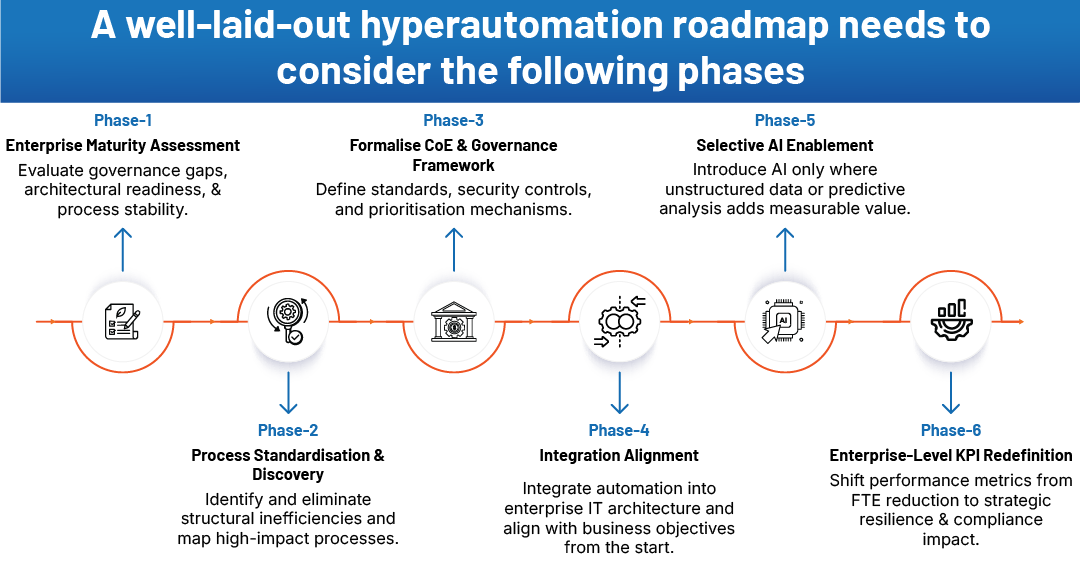
A well-laid-out hyperautomation roadmap needs to consider the following phases:
- Phase 1: Enterprise Maturity Assessment
Evaluate governance gaps, architectural readiness, and process stability. - Phase 2: Process Standardisation and Discovery
Identify and eliminate structural inefficiencies and map high-impact processes. - Phase 3: Formalise CoE and Governance Framework
Define standards, security controls, and prioritisation mechanisms. - Phase 4: Integration Alignment
Integrate automation into enterprise IT architecture and align with business objectives from the start. - Phase 5: Selective AI Enablement
Introduce AI only where unstructured data or predictive analysis adds measurable value. - Phase 6: Enterprise-Level KPI Redefinition
Shift performance metrics from FTE reduction to strategic resilience and compliance impact.
However, implementing an effective hyperautomation roadmap is a structured initiative that demands technological foresight and expertise. This means companies must have a full understanding of security and governance frameworks and be well-versed in identifying existing operational gaps.
This level of strategic clarity is often missing. This is where RPA consulting service providers deliver value to UK enterprises.
Where RPA Consulting UK Services Add Strategic Value
RPA consulting helps UK enterprises have a full understanding of existing workflows, including those that are broken and inefficient.
Reliable service providers such as Evoke Technologies provide end-to-end intelligent automation roadmaps. These roadmaps determine the appropriate tool stack for seamless system integration while avoiding vendor lock-ins. Evoke’s RPA specialists, for instance, help companies streamline and accelerate error-prone and critical tasks with smart low-code and RPA solutions.
These consultants help companies build hyperautomation workflows with embedded data security and governance frameworks by design. This results in secured bot deployments, which are non-negotiable in regulated sectors like healthcare, banks, and finance. Evoke’s RPA CoE ensures automated processes adhere to UK regulatory requirements, including GDPR and financial compliance standards.
Lastly, RPA consultants can empower companies’ teams, help familiarise them with process automation, and its management. This reduces internal friction and helps usher in a cultural shift in favour of digital transformation.
RPA in the UK has shifted from experimentation to full-scale automation. Competitive advantage now lies not in deploying more bots, but in strategic scaling of automation across workflows.
However, successful implementation of hyperautomation involves analysis of existing operations, architectural readiness, an embedded governance framework, and in-depth technical knowledge. Most UK enterprises fail to scale RPA due to the absence of these foundational elements. The resultant unstructured scale risks fragmentation and rising costs.
This is where Evoke’s RPA consulting services deliver value to the UK enterprises. Equipped with proven methodologies, technological expertise, and an in-depth understanding of UK regulatory compliance, our RPA experts help businesses effectively upgrade from pilot projects to enterprise-grade hyperautomation.
We leverage CoE enablement, governance frameworks, and business-aligned integration processes to deliver automation that ensures security, sustainability, and agility.
Connect with Evoke to learn more.