


Your organization’s security probably works like a castle: strong walls around the perimeter, but once someone gets past the gate, they can go anywhere.
That is the problem.
Modern attacks do not care about your castle walls. They get inside through stolen passwords, phishing emails, or compromised vendors. Once inside, attackers can access everything because the old security model says, “If you are inside, you are trusted.”
Zero Trust security flips this completely. Instead of trusting people once they are inside, it says:
“Never trust. Always verify. Everyone and everything.”
The Three Simple Rules of Zero Trust Security
Rule 1: Verify Everyone, All the Time
Before granting access to anything—a file, an email, a system—verify:
- Who are they? (Is this really Jane from accounting?)
- What device are they using? (Is it their company laptop or a hacked personal computer?, a Smart sensor or an OT system?)
- Where are they? (Is this their normal location?)
- Does this seem normal? (Are they trying to access something unusual?)
The key: Do not verify once. Keep verifying throughout their entire session. If something changes—a new location, suspicious activity, risky behavior—access is denied immediately.
This is called “continuous verification.”
Rule 2: Give People Only What They Need
Your accountant does not need access to marketing’s customer list. Your IT technician does not need to read confidential emails.
Under Zero Trust, everyone gets minimum access for their specific job:
- Accountants see accounting files only
- Developers see code repositories only
- Managers see their team’s data only
Access is also temporary. If someone changes roles, their old access is removed within hours, not days.
This principle—“least privilege”—is critical because if an attacker steals someone’s password, they cannot access everything. They are limited to what that person could access.
Rule 3: Assume You Are Already Hacked
Here’s the uncomfortable truth: Most organizations will eventually get hacked. It might be through phishing, a compromised vendor, an employee’s stolen credentials, or insider threats.
Zero Trust assumes this will happen. Instead of just defending the front door, you defend everything inside too:
- Separate networks into zones so one breach doesn’t expose everything
- Monitor all activity so you catch attacks quickly
- Enable rapid response so you contain damage before it spreads
- Design systems so attackers cannot move freely
When breaches are detected in days instead of months, damage is contained.
Why Zero Trust Security Matters Now
Your company’s perimeter used to be clear: the office building. Now? Your team works from home, coffee shops, and everywhere else. Your data lives in the cloud. Employees use personal devices. You use dozens of SaaS applications.
There is no perimeter anymore.
Meanwhile, attackers have evolved. 95% of breaches now involve stolen credentials or inside access—not someone breaking through your firewall. Perimeter security cannot stop these attacks.
Zero Trust security was designed for today’s reality where:
- People work anywhere
- Data lives everywhere
- Threats come from inside
- Your “network” is distributed and borderless
Regulatory pressure is accelerating the AI + Zero Trust intersection. The EU AI Act, the NIST AI Risk Management Framework, and sector-specific regulators all now expect documented accountability for autonomous systems — accountability that rests on identity, audit, and access control, the same primitives Zero Trust already governs.
What Changes?
As an Employee:
You might need to log in more often and authenticate in more ways. You will probably notice tighter controls on what files you can access. Your company will monitor suspicious activity (but not spy on you—they are looking for hacks).
Reality: Most people barely notice the difference in daily work.
As a Manager:
New employees will have security setup included in onboarding. When people leave, access is removed immediately instead of getting “lost in the process.”You will have better visibility into who accesses what.
Reality: Faster onboarding, faster offboarding, more control.
As an IT Leader:
You will have much better visibility into what is happening. You can set policies that automatically enforce security instead of manually approving thousands of access requests. You will detect breaches faster and respond in hours instead of weeks.
Reality: Operational efficiency improves. Response time plummets.
The Six Areas to Protect
Zero Trust security requires protection across six areas:
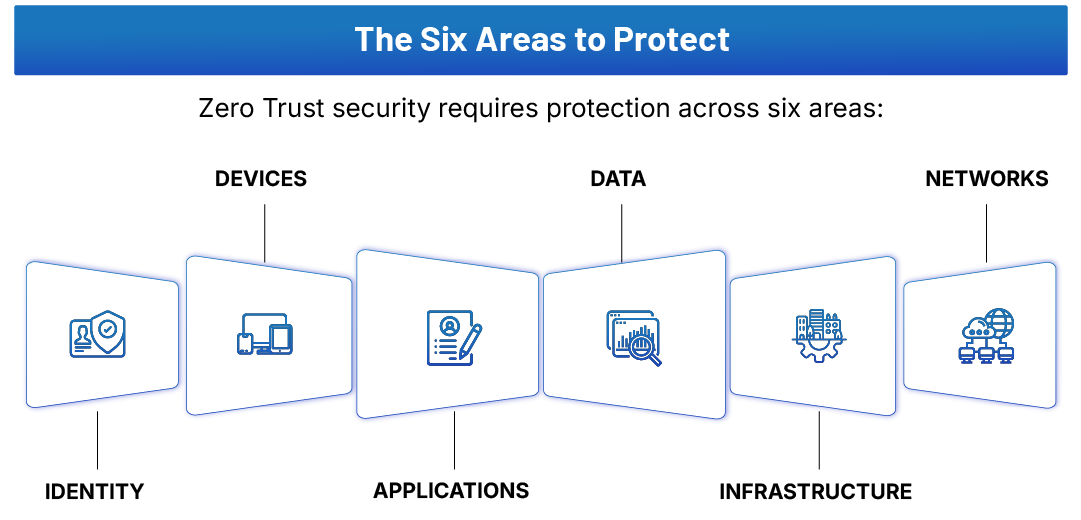
- IDENTITY: Who people, devices, and systems are. Use strong passwords, multi-factor authentication, device identity, and continuous verification so only trusted users and approved IoT or OT assets can connect.
- DEVICES: Computers, phones, IoT sensors, cameras, smart equipment, and OT assets. Keep them updated where possible, verify their health, maintain a clear inventory, and control what each device can access.
- APPLICATIONS: The software people use. Protect apps and the connections between them so they cannot be hijacked.
- DATA: The most valuable target. Classify what is sensitive, encrypt it, watch who accesses it, and prevent it from leaving.
- INFRASTRUCTURE: Servers, cloud systems, gateways, industrial controllers, and plant-floor systems. Apply the right security settings, monitor behavior, and protect uptime as well as data.
- NETWORKS: The connections between systems. Separate IT, IoT, and OT environments into zones, encrypt traffic where feasible, and use segmentation to stop one compromised device from reaching critical operations.
The Real Impact
Organizations that implement Zero Trust Security report:
- 60–80% reduction in breach likelihood
- Breach detection time drops from 207 days to 3–7 days (11 months down to a week)
- Incident response time: Hours instead of days
- Unplanned costs from incidents: Cut by 35–50%
A single prevented breach pays for the entire Zero Trust investment.
Is Zero Trust Security Complicated?
Implementing Zero Trust is not a quick fix—it is typically a 3–5 year journey. You start by assessing where you are, running a pilot on your highest-risk areas, then expanding gradually.
But it doesn’t need to be complicated to understand:
- Never trust by default
- Always verify access
- Give people only what they need
- Assume breaches will happen
- Protect everything inside, not just the perimeter
These five ideas are the foundation. Everything else follows.
Bottom Line
Zero Trust security is about treating every access request as potentially dangerous and verifying it before granting access—then continuously validating it throughout the session.
It requires more effort upfront, but the payoff is clear: reduced breach risk, faster detection, and minimal damage when incidents occur. That is why leading organizations are moving quickly—often with partners like Evoke Technologies—to turn Zero Trust from strategy into execution.
In a world where your workforce is remote, data is distributed, connected IoT and OT environments are expanding, and threats come from within, Zero Trust security isn’t optional—it is essential.
It is the new foundation of security.
Start thinking about it now. Your competitors already are. And many are accelerating their journey with Evoke Technologies—strengthening security, improving visibility, and building resilience across their ecosystem.
Ready to move from awareness to action?
Contact us to assess, design, and implement your Zero Trust strategy with confidence.